The DOD has told Congress that retirement of the U-2 fleet will save $600 million annually. Meanwhile, actions to retire the Dragon Lady fleet have already begun, although NASA wants to keep its two ER-2 research aircraft in service.
The Pentagon recently sent a written waiver to Congress justifying the divestment, as required by legislation that was enacted in 2018 and 2021. It said that the money to be saved will be reinvested to “accelerate development of more advanced, and survivable, penetrating and persistent capabilities in order to maintain a combat edge against pacing threats.” A supporting analysis has also been written, but is classified.
The “survivable capability” must be a reference to the Penetrating ISR (P-ISR) UAV variously known unofficially as the RQ-180 and The White Bat. A “persistent capability” could also refer to reconnaissance satellites. My previous discussions of these systems can be found here and here.
On previous occasions when the USAF has proposed retirement of the U-2, the leadership of the Combatant Commands has successfully objected. I am not aware of any such intervention this time, and the waiver claims that “divestiture of the U-2 will not prevent the Combatant Commands from accomplishing their missions at acceptable levels of risk.”
The waiver also certifies that “a greater capability is worth increased operation and sustainment costs.” This is puzzling, since the proponents of UAVs have always claimed that they cost less to operate than manned aircraft. This might be especially true when compared to the U-2, because of its rigorous and extended pilot training program, and the unique costs of the pilots’ life support system (eg the pressure suit and helmet).
On the other hand, the P-ISR has cost billions of dollars to develop, and may be costing a great amount to operate. The B-21, which is also made by Northrop Grumman and shares design characteristics with the P-ISR, is costing nearly $15 billion to develop, not counting the pre-Fiscal Year 2022 expenditure. The unit production cost of the B-21 will be about $700million at current prices if 100 are acquired, plus another $200 million in support costs per copy.

Meanwhile, the first U-2s are being retired. At Beale, one of the four twin-cockpit trainers (80-1065, above) was grounded last month because it was due for programmed depot maintenance (PDM). The USAF has told the Skunk Works to stop work on the latest two U-2S to enter PDM at Palmdale. Three more jets undergoing overhaul there will be completed, but the fate of the sixth aircraft in the depot remains uncertain. This is 80-1099, the one that suffered a hydrazine fire many years ago, went into storage, and was removed for restoration in 2021. It is almost ready to fly again.
I understand that the Skunk Works is making a pitch to keep a few U-2s flying at Palmdale as test beds for systems being developed for classified programs. The Dragon Lady has often performed this role in the past, and up to the present.
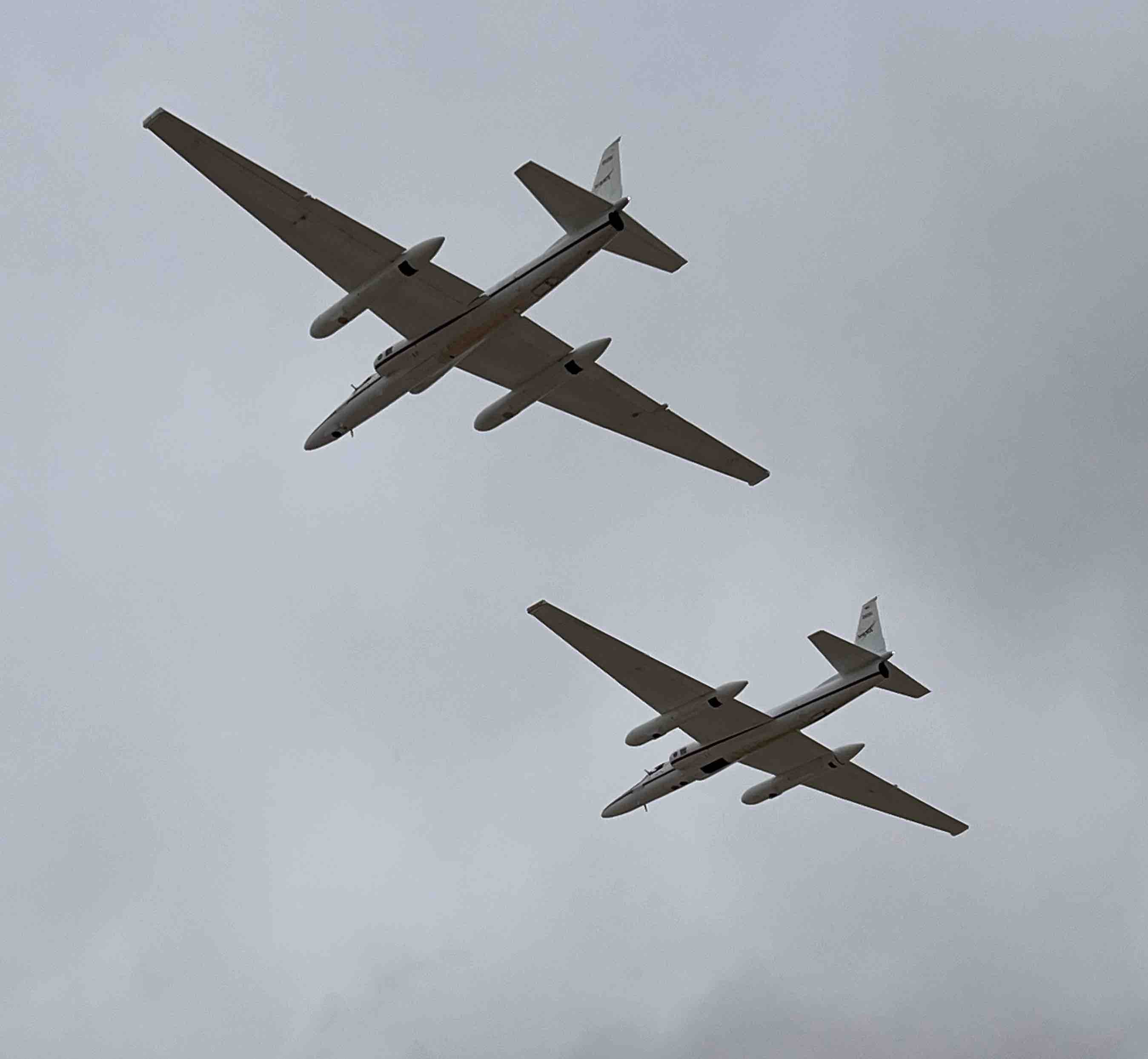
Meanwhile, NASA wants to keep its two ER-2s flying indefinitely. They have been based at Palmdale alongside NASA’s Boeing 747SP Stratospheric Observatory for Infrared Astronomy (SOFIA), plus a DC-8 and a C-20 Gulfstream. Now that the 747 has been retired, with the DC-8 to follow in April, NASA is vacating its hangar at Palmdale. The two ER-2s are joining the rest of NASA’s fleet at Edwards AFB, to where they were flown in formation two weeks ago (below).
 Dragon Lady Today
We have nothing that is manned to fly (in USAF) that goes to an altitude of 70,000 ft. Now what?
Will be interesting to see where they put the U-2 at. In storage inside, museums or destroyed like the F-117.
Sad indeed, seeing how the B-52 is still flying after some 60+ years and going for 100. My Dad is most likely turning over in his grave after this, as he was a debriefer on the U-2 back in the 100th SRW at Davis-Monthan AFB when the U-2 was stationed there till 1976.
Redleader one…..out!
LikeLike
I HAVE COVERED A HUGE CHUNK OF THE WORLD WITH THEM IN CLUDING 2 TRIP TO VIETNAM AND WAS TREATED TO A RIDE IN THE 2 SEATER
LikeLike
I CAN’T BELIEVE THE USER COMMANDS HAVE NOT COME TO IT’S SUPPORT FOR THE FANTASTIC ISR CAPABILITY IT HAS. I CHECKED OUT IN THE ORIGINAL A MODEL IN 1957 AT THE BEGINNING OF THE AF PROGRAM AND FLEW IT FOR 9 YEARS. I HAVE FOLLOWED THE UNBELIEVABLE IMPROVEMENTS AND MODIFICATIONS THAT HAVE FOLLOWED AND FIND IT UNELIEVABLE THAT IT COULD NOW BE TERMINATED. PAT HALLORAN
LikeLike
Two additional U-2s have been retired since January, and four of the U-2s still in service happen to be the only remaining examples of the first-generation U-2R flown in 1967 that are still flying, making them older than the rest of the active U-2 fleet. Therefore, the U-2s with serial numbers 68-10329, 68-10331, 68-10336, and 68-10337 may be retired soon.
It may have been paradoxical that the US Air Force gave in to pressure from the CIA to buy the U-2 after being surprisingly impressed by flight tests of the U-2 at Area 51 given that General Curtis LeMay had criticized this plane as too aerodynamically frail to be a practical military aircraft, but the U-2 was able to adapt to the post-Cold War security environment as evidenced by its participation in spy missions over the Balkans, Afghanistan, Iraq, and Libya but also its cheaper operating costs relative to that of the A-12 and SR-71 that were intended to replace it.
The unmanned stealthy P-ISR flying wing built by Northrop Grumman and informally dubbed “RQ-180” may be expensive, but its design philosophy might engender lower maintenance costs than those of the SR-71. If the Boeing GQM-94 B-Gull had gone into service, then the U-2R would have retired in the early 2000s and the GQM-94 might have fulfilled a great many surveillance and ELINT duties currently performed by the U-2 and RQ-4.
LikeLike