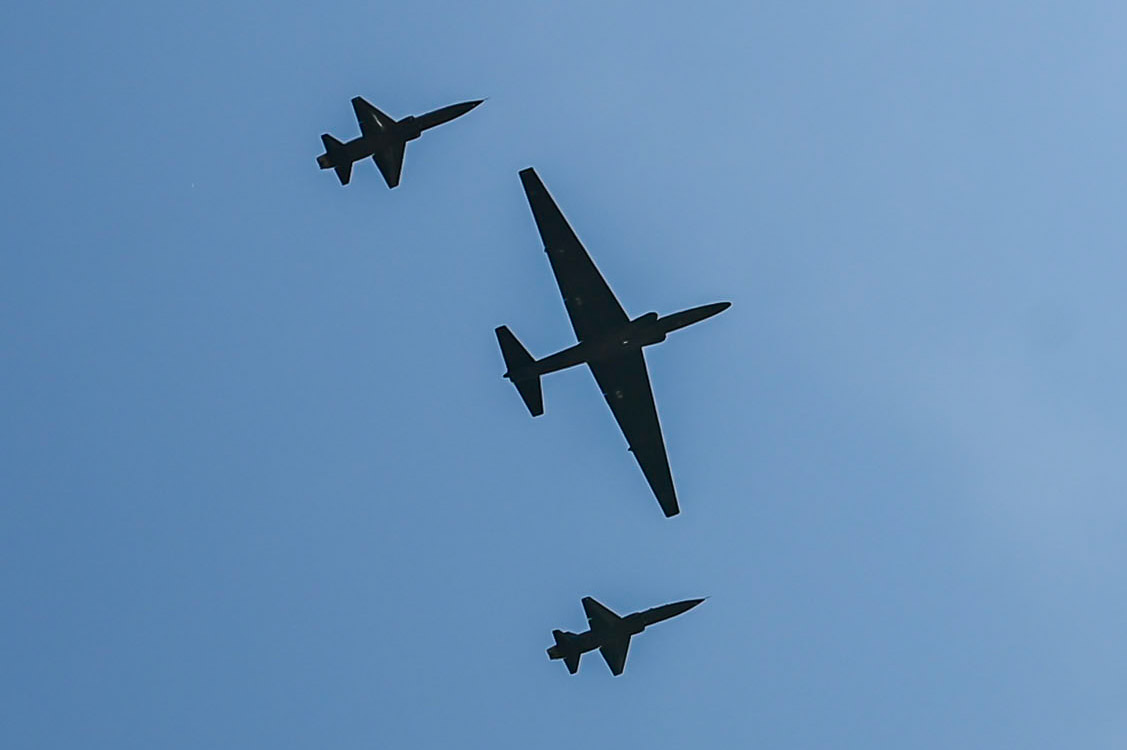
Just weeks after Secretary of the Air Force Troy Meinke and USAF chief Gen David Allvin restated the USAF’s desire to retire the U-2, a key Congressional committee has said that it should do no such thing. The USAF was planning to cease U-2 operations at the end of September, and retire the fleet during Fiscal Year 2026, which begins on 1st October. But the House Appropriations Committee (HAC) decreed this week that in FY2026, “no funds…may be used to divest or prepare to divest more than eight U-2 aircraft.” Further, the Committee provided $55 million “for U-2 programmed depot maintenance [PDM] to fully restore three aircraft.”
The language comes from the HAC’s markup of the President’s FY2026 budget request, even though only an outline of that plan has been provided by the Trump Administration. The detailed request from the Pentagon with program-by-program justifications, has still not been published. “The HAC got sick of waiting, and went forward on their own,” an informed source on The Hill told me.
This is the same committee that called a halt to the USAF’s divestment plans in the current fiscal year. However, its latest action must be endorsed by the Senate Appropriations Committee, which may take months. Meanwhile, the U-2 program remains in limbo, as it has for the whole of this fiscal year.
There are currently five jets parked at Beale, and three at Palmdale, where the Skunk Works was told to stop work on their PDMs in January 2024. It will presumably now try to reinstate the workers that were let go last year. A number of U-2 people have told me that the depot at Palmdale is ‘the long pole in the tent.’ Without it, fleet numbers will inevitably decline as more aircraft reach the hours or time when a PDM is required.

 Dragon Lady Today
Thanks Chris. I was hoping saner minds might prevail! Makes no sense with nothing to really fill the intel gap. Buz
LikeLike
USAF have tried for years to get rid of the U2, haven’t succeeded yet.
Would love a T Shirt with the logo on.
LikeLike
LikeLike
The U-2 was supposed to be replaced by the Archangel-12 (A-12) and SR-71 because it was vulnerable to SAMs like the SA-2, but it ended up outlasting the SR-71 in service due to its low operating costs.
The USAF impetus in the early 2000s for restarting efforts at shopping for an SR-71 successor was partly due to its recognition of the fact that the U-2 and RQ-4 were vulnerable in contested airspace.
LikeLike
You don’t throw away your trusty hatchet!
LikeLike
Buzz. The last time it was the Theater Commanders that stopped the divestment. I pray that the AF reconsiders its effort to divest. We provide a NRT look at the world. As we see things unravel globally, our take is very important. Paul
LikeLike
70 years over 70,000… may make 80 years !
let’s hope sanity infects DC
LikeLike
After the LCT report came out early 1999, I believe the Air Staff cut that back to only an additional 80K. Call it a safety factor or (likely) skepticism.
During our LCT ((limit load) life-cycle testing) review in 1998, the airframe/wings showed “good” (robustness, elasticity) out to 120,000 hours. We (the results of 13 sorties of flight test) predicted that on 2089 the oldest jets would see their first retirement dates.
We ain’t even close to that today!
What a treat in those initial builds to have milled the wings out of solid sheets of aluminum. We hid the tooling in oil in the 50’s, and uncorked them for the R-model in the 60’s. Thanks, Kelly! – and as always, thank you blessed maintainers. – skid rowe
LikeLike
Reminds me of the SR-71 saga🤔
LikeLike