
The Lockheed Martin Skunk Works marked the 70th Anniversary of the U-2 with a ceremony at Palmdale on 31st July. The event was held in the big hangar at Site 2, where Programmed Depot Maintenance (PDM) has been done on the U-2 fleet for many years. Most of the more than 400 attendees were LM employees associated with the Dragon Lady in the past or present. But senior leadership was also present, as well as local and state politicians – and myself.
“The U-2 has stood as a symbol of innovation and excellence for seven decades, and we’re proud to share its legacy with you,” said deputy U-2 program manager Cam Edwards, who compered the event.
“The fact that the U-2 is still flying seven decades later, still delivering unmatched capability is not just a testament to the platform. It’s a testament to the people, “ said O.J.Sanchez, the new head of The Skunk Works. “Every technician, every engineer, every pilot, every service member, every team member – you’ve made this legacy possible. You’ve evolved it, sustained it, and ensured it stays ahead of the threat. That’s no small feat.”
Then came Greg Ulmer, president of Lockheed Martin Aeronautics, who said: “For 70 years, the U‑2 has done what no other aircraft could—flying at the edge of the atmosphere to provide decision-quality intelligence to commanders, policy makers, and warfighters. From the Cold War to Desert Storm, from Kosovo to Syria, from China to today’s multi-domain operations, the U‑2 has answered the call – again and again -delivering critical intelligence when our nation needed it most.”
In a veiled reference to still-secret programs in The Skunk Works and elsewhere, Ulmer added that “the platform’s contributions to multi-domain command and control, to rapid ISR integration, to open mission systems, and to AI-enabled operations are shaping the next generation of capabilities. What the U‑2 proved possible is now informing what comes next.”
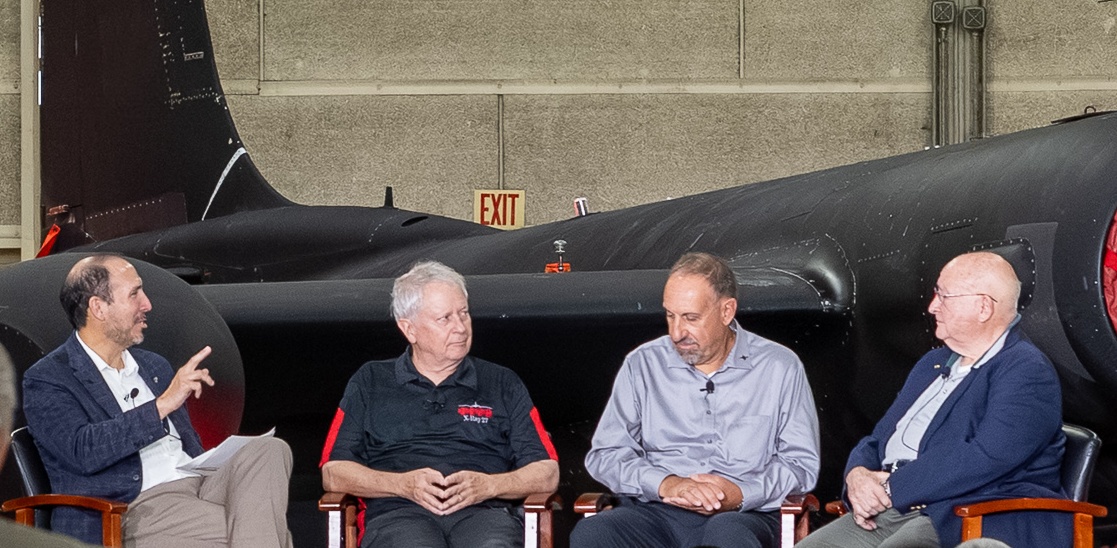
The speeches were followed by a panel of three distinguished former U-2 pilots:
- Rob “Skid” Rowe, who flew the Dragon Lady operationally from 1986, and later became the chief U-2 test pilot at Palmdale. Skid has logged the second-highest number of hours on type – 5,413.
- Mike “Sooch” Masucci, another USAF driver who soloed in 1990 and later also became a U-2 test pilot. Most recently, Sooch has been flying into space for Virgin Galactic.
- Lionel “Stormy” Boudreaux, who flew both the SR-71 and (from 1979 to 1992) the U-2 in the USAF, before joining ADP as U-2 Systems Engineer

After some closing remarks from O. J., group photos were taken and 70th Anniversary merchandise was made available.
The backdrop for the event was 68-10331, the resident U-2S at Palmdale, where it test-flies new hardware and software for the U-2, and other programs. It has been fitted with Link 16, an open mission system and the “Avionics Tech Refresh”, and recently test-flew the production ASARS-2B imaging radar for the first time. All these upgrades were planned for at least eight aircraft, until the USAF decided to retire the fleet.
331 is the second-oldest U-2 still flying, having first taken to the air in February 1968. It was delivered to the CIA in November 1968, and was subsequently flown by Republic of China Air Force (ROCAF) pilots from Taiwan. It was transferred to the USAF in 1974, when the CIA ended its U-2 operation. Recent research by my good friend Lin Xu has revealed that 331 escaped a surface-to-air missile attack by mainland China in 1972 while flying along its coast in international airspace.

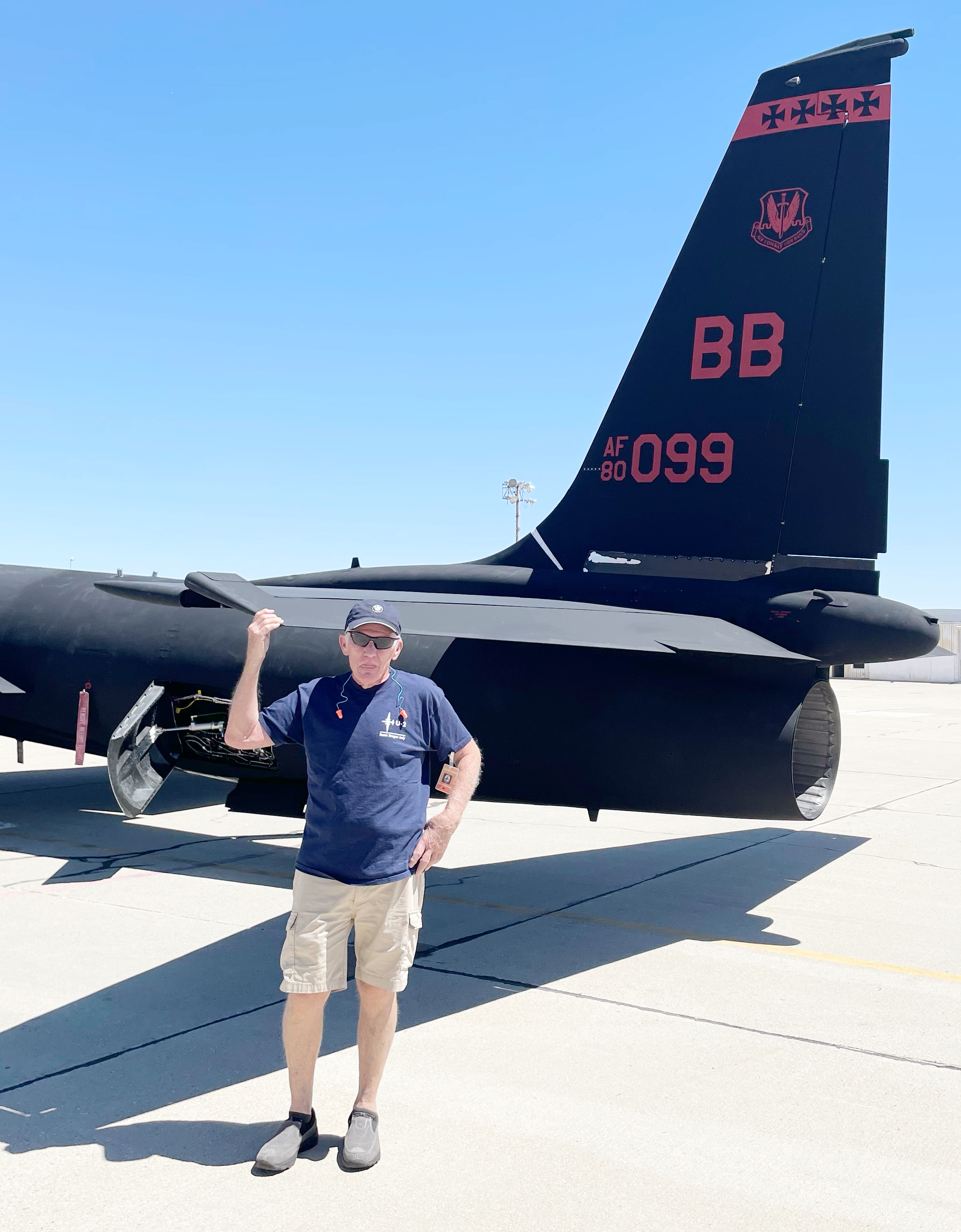
Also present at Site 2 was 80-1099, the U-2S that was damaged by a hydrazine fire on the ground at Al Dhafra in 2008. It was dismantled and returned to the US at Warner Robins AFB, where it was stored for 11 years. In 2019 the USAF decided to return it to flight, whereupon it was moved again, this time to Palmdale. It finally flew again for the first time in 17 years last week, and will soon be delivered to Beale. It has recently been nicknamed the “Frankenjet” because its fire-damaged tail was replaced by the one from 80-1089, which was written off after a serious collision with a vehicle at Al Dhafra in 2019.
Also in the hangar at Site 2 were 80-1073 and 80-1083, two aircraft that had entered PDM and been dismantled and stripped, when the USAF issued a stop-work order in early 2024. Those aircraft could now be completed and returned to service, if a proposed Congressional mandate is enacted. The U-2’s future remains uncertain, but the USAF’s plan to end operations next month has been postponed for at least a year.
 Dragon Lady Today
Great to see the U-2 is still flying and is having a hard time retiring, unlike me. Tony
LikeLike